
Midsummer Zeitgeist
The afterlife of Danceteria—and the other things I can't stop thinking about.

The afterlife of Danceteria
Nightclubs are supposed to disappear. That’s part of their appeal. They exist for a moment before being demolished, renovated or simply fading into memory. Every so often, though, one escapes history and enters mythology.
Danceteria seems to be enjoying an unexpected afterlife.
Madonna hardly needs any more publicity for her current album, but I’ve found myself almost more interested in the cultural ephemera orbiting it than the record itself. In particular, I enjoyed the whirlwind walk through her downtown New York history on Danceteria and the absurdly star-studded accompanying film, but even more I’ve enjoyed the essays, podcasts and conversations it has sparked.
From Poppantheonpod and Russlessless’s breakdown of “every namecheck in Madonna’s Danceteria” over on Patreon to Joy Press’s excellent “oral history” piece for Vanity Fair (despite the rather lifeless AI narration), I’ve happily disappeared down the rabbit hole. Add to that Soft Cell’s forthcoming Danceteria album and its already released title track, and suddenly two very different artists are trying to summon the same vanished world.
Both Madonna and Marc Almond lean into spoken word, hip-house and half-rapped nostalgia, dropping names and fragments of memory in an attempt to reconstruct an atmosphere. Unsurprisingly, Marc’s version feels steamier, darker and more feverish. “I wanna be near you forever... Danceteria forever,” he sings, sounding less like someone remembering a nightclub than mourning the disappearance of an entire cultural ecosystem.
When two cultural icons independently return to the same long-lost nightclub, it feels like more than coincidence. Danceteria has moved beyond being simply a place. It has become a myth.
What was it about downtown New York that continues to exert such a pull? Was it the sense of possibility? The proximity of danger? The collision of music, fashion, art, nightlife and queer culture? Or simply the fact that these scenes developed slowly enough to become genuine cultures rather than viral trends?
The current narrative suggests that Gen Z are nostalgic for analogue culture, but what’s interesting is that much of this revival is actually being driven by older generations using precisely the technology that’s supposedly replacing it. Instagram, Patreon and YouTube have become vast archives where people surface, annotate and re-share the cultural fragments they half remember and half want to rediscover.
Perhaps what we’re really nostalgic for isn’t analogue itself but the slower rhythm of cultural change. Scenes once had time to percolate, evolve and sometimes burn themselves out before the rest of the world even noticed.
Fashion reflects this too. Clothes originally worn out of economic necessity have become desirable vintage artefacts: cut-off denim jackets, battered trainers, faded tracksuits. I’d love to stumble across an original Danceteria or Paradise Garage T-shirt.
It also makes me wonder what people thirty or forty years from now will see as emblematic of the 2020s. Oversized silhouettes. Uniqlo basics. Salomon trail shoes worn nowhere near mountains. Foam Birkenstocks. Quiet luxury. The ubiquitous tote bag. Which of today’s everyday objects will acquire the romance of authenticity once they’re safely in the past?
Perhaps that’s what an afterlife looks like. Not a faithful reconstruction, but a place continually reinvented by the people who were there, and by those of us who wish we’d been there.
On the reading pile
The current reading stack feels strangely coherent, despite appearances.
I’m reading J. G. Ballard’s The Drowned World for Boys’ Book Club, which currently feels less like speculative fiction than a weather report given London’s swamp-like temperatures. Alongside that are the more recent Yesteryear, Last Resort, Tonight the Music Is So Loud and The Smiths.
If there’s a thread connecting them, it’s an attempt to understand the present through the past. Whether the subject is climate change, sexual politics, music or subculture, each offers a different lens through which to look at the world we’re living in now.
Sometimes nostalgia isn’t about wanting to return. Sometimes it’s simply a way of understanding how we got here.
Bleached denim


Bleached denim has quietly become one of the recurring motifs of the season.
It surfaced at both Dries Van Noten and JW Anderson’s signature line, carrying with it decades of counter-cultural references while somehow still feeling fresh. What I particularly love is how unpredictable the bleaching process becomes. As Dries’s previous experimentation with bleaching revealed, every piece develops differently, creating marbled patterns that feel almost Rorschach-like.
It’s the SS27 shorts that have really caught my attention. Styled with khaki tailoring and washed pale blues, they somehow feel both nostalgic and entirely contemporary.
The search for the perfect pale blue summer shirt
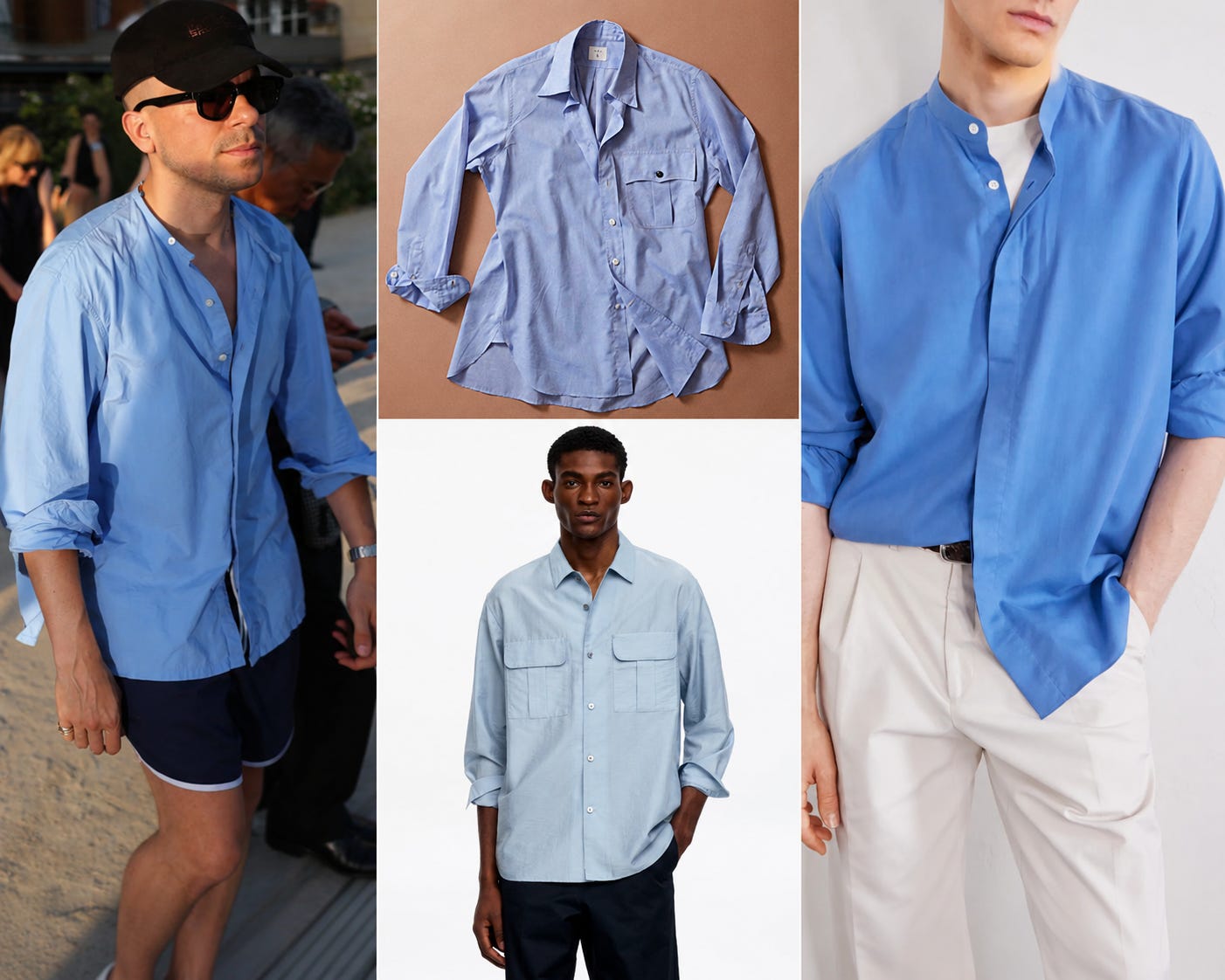
Compared with feverish memories of pre-gentrified downtown Manhattan, obsessing over a pale blue shirt might sound rather pedestrian.
Yet it has quietly become my summer fixation.
There’s something about the slightly oversized pale blue poplin shirt that fashion editors seem instinctively understand. Not freshly pressed, but not deliberately crumpled either. Sleeves casually pushed back. Collar just beginning to soften. Hanging loosely over shorts or relaxed tailoring. The sort of shirt that looks completely anonymous while somehow being impossible to replicate.
The best versions remain frustratingly expensive. LEJ’s is still probably the benchmark, although both the cotton and silk versions being out of stock has at least removed the temptation. Anderson & Sheppard’s captures exactly the right shade of blue.
At the more affordable end, Arket is clearly chasing the same officer-shirt silhouette, although I can’t quite get past the sheen of the Tencel blend. Poplin still feels like the answer.
The search continues.
Images that made me stop scrolling


A handful of photographs have stayed with me this week.
NY Magazine’s Samuel Hine photographed during Paris Fashion Week wearing white Repetto dance shoes looking impeccably summery. Stephen Linard photographed by Derek Ridgers, a reminder of just how genuinely anarchic fashion once felt - not simply unconventional but actively unsettling to previous generations.
And then there’s the return of the rock T-shirt.
Or perhaps more accurately, the return of the return of the rock T-shirt.
I remember Katy England saying, during the first great revival of band tees in the Hoxton era, “They have such great art on them.” I’ve noticed them appearing again on editors and stylists throughout the recent menswear shows, worn with exactly the kind of studied nonchalance that makes fashion endlessly cyclical.
Cue the return of the Tisci-era Givenchy Rottweiler.